Showing posts with label Catholic Church. Show all posts

Monday, May 18, 2026

A Tale of Two Novels

I recently finished two novels that I was surprised had some significant similarities but yet wildly different takes.  I thought it might be good to talk a little about the two, and in particular, to warn against one of them.

The two novels in question are M.R. Leonard’s Pilgrims and Douglas Preston and Aletheia Preston’s Paradox.  Both are the debut novels for an author (Leonard and Aletheia, the daughter of Douglas).  Both have connections with the question about life on other planets.  Both have connections to the Catholic Church.  Everything else, past this paragraph is major spoilers, because that is the only way to discuss them further.  So, if you’re interested in reading them, but don’t want to be spoiled, stop at this paragraph.  I will just say this summation: I have already recommended Pilgrims to others; I will never recommend Paradox to anyone.


In Pilgrims, humanity has been preparing for an alien invasion for 5 years, since the first sign of them approaching Earth.  The main character is a Latin teacher, Austin DeSantis, who loses his job and is desperate for money.  When the aliens arriving, hovering in ships over major cities, the world is shocked when they start speaking in Latin.  The government forces Austin to act as an interpreter, or face death for being an accomplice to murder.

The aliens, it turns out, are Catholic, hence the Latin.  Austin becomes a pawn of the US government, who want to use him to infiltrate the aliens, gain their friendship, then bring them down.  He, reluctantly, becomes friends with one of the aliens and a Catholic priest-astronomer who has also been chosen to visit the alien spaceship.

Why do the aliens speak Latin?  Why are they Catholic?  Thousands of years ago, through their intellect they came to know that there was a God, but they didn’t know Him until they visited Earth and witnessed Jesus’ Passion, death, Resurrection, and ascension.  When they share their “videos” with the world as proof, Muslims nuke the Vatican, killing the pope.  In retaliation, the aliens completely wipeout every non-Christian in Saudi Arabia.  In an attempt to stop the aliens, the priest agrees to celebrate Mass on the spaceship, allowing them to receive Jesus.

Lots more happens, but in the end, the world is saved, and Austin is on the path to conversion.  It’s a compelling story, and deeply Catholic.  My minor qualms come down to how the priest celebrates Mass on the spaceship.  I’m also not entirely convinced that it is a “sci-fi retelling of Augustine’s Confessions.”  It is much more of a “thinking” sci-fi, with not much action.  But for what it is, it is interesting, it keeps the reader engaged, and, as I said, I have already recommended it to others.  (An aside: a non-Catholic actually recommended it to me, which was interesting)


The other novel I just finished reading is Paradox, a sequel to Extinction, which I read last year.  Extinction was not quite the updated Jurassic Park that some reviewers claimed, but I still found it interesting and I wanted to see what happened next with the Neanderthals on the loose.


There’s a lot going on in Paradox, but the “Neanders” are nowhere to be found, except as an occasional reference to the previous book.  Essentially, an exobiologist breaks into a church in Rome, steals part of the skull of St. John the Baptist, and an Irish monk is sent to America to bring it back.  Meanwhile, an eccentric prospector and UFO conspiracy theorist is found murdered in his cabin in Colorado (which brings in the main characters, Cash and Colcord, from Extinction).

Where do I begin with how this novel upset me?  First, there is the “trans” reporter who is referred to as “they/them,” making it almost impossible to follow scenes with her because of the stupid plural referring to singular.  So, it’s woke.  Second, there is the problem with the Catholic Church.  The murderers use Inquisition torture methods, because of course the Inquisition is evil.  They also kill two of the characters who are Catholic by stuffing them with the Eucharist, you know, as Viaticum (oh, and by the way, at the end of the book a female character performs the “Last Rites,” because the authors didn’t bother to actually research anything).  Then there is the small-town priest who is portrayed as evil because he prefers the Latin Mass and says that people misunderstand the Inquisition.  Never mind that, in the end, he helps save Cash and Colcord, he still is seen as a crazy person not to be trusted.

Then there is the realization at the end of the novel that “upends everything people think they know about religion.”  You see, Jesus and his apostles (which apparently include John the Baptist?) were all aliens.  So, he wasn’t really God, just an alien with super powers.  I’m all for science fiction and interesting stories, but I draw the line at blasphemy.  In an Afterword, the authors try to explain it all as a fun little theory that some people have, but they also scoff at such theories being a threat to the Church.  It’s all a fiction account, after all, no harm done.  I’m glad it makes it easy for me to say I will never read another book from Douglas Preston again.

Wednesday, December 24, 2025

52 in 25: #51 - Love Does Such Things

There is a tradition in Advent to prepare for Christmas started by my parents years ago, and now I continue it on.  Every year, I read this beautiful little book called Love Does Such Things by Reverand Mary Raymond, O.C.S.O, published in Milwaukee in 1955.  It is a real treasure, and a book I highly recommend picking up if you can find it.


Fr. Raymond walks through the Christmas story, from the Annunciation through the return to Nazareth after Egypt.  Each chapter represents a different letter, to spell out the ultimate word of Christmas: “SAVIOUR.”  So the chapters are: Shepherds and Sheep, Angels, a Virgin, Nativity and Name (J=I), Offerings, Urgency, and Return and Retirement.  In the end, he sums it all up that God does all of this for you, for whom Love Does Such Things.


I love this book.  Each time I read it, something else jumps out at me.  I can’t tell you how many times little tidbits have made their way into my homilies during the Christmas season.  It also has beautiful paintings recreated in it.  I think it would be awesome if someone like TAN reprinted it to make it more available, because right now the only way to get it is to find it second hand (apparently there was a recent reprint, but it also is not available and it looks like it’s missing the original images).  Again, if you can, get a copy and enjoy it for years.


Monday, November 24, 2025

52 in 25: #47 - That Nothing May Be Lost

I think I mentioned this before, but I take my time with my spiritual reading.  This was no exception.  I just completed Rev. Paul D. Scalia’s That Nothing May Be Lost.  If that name is familiar, he is a priest for the Diocese of Arlington and the son of Supreme Court Justice Antonin Scalia.  I first became aware of him listening to his homily for his dad’s funeral in 2016.  It’s the best funeral homily I have heard, it inspires mine, and it is included in the appendix of this book.


I had picked up this book a number of years ago, but finally got to reading it.  It is a collection of his work, including some articles he has written and (I think) some homilies.  Topics range from the Sacraments to saints, including Mary, to prayer, feast days, and, of course, Our Lord.  I love this book because it is easy to pick up, read one or two, and reflect on his words.  He also does a great job, since these are written for your typical lay Catholic, of distilling ideas down into something that is easily consumed but will keep you thinking.  I highly recommend this book to enrich anyone's spiritual life.


Friday, October 31, 2025

52 in 25: #42-44 - "Research reading"

I am slogging through my “fun” reading right now, but remember I should mention the reading I am doing for “research.”  Here’s “3” books that I have read for a project I am working on.

The first is Soul Searching: The Religious and Spiritual Lives of American Teenagers by Christian Smith with Melinda Lundquist Denton.  I first came across this book while listening to the Bible in a Year podcast.  It is a little bit dated, since it is focused on teenagers at the turn of the century and a lot has happened since then, but it is an insight into how many Americans still view God.  Essentially, it is based on a survey and a series of interviews with teenagers around the year 2005.  The end result was their conceptualization of a new belief system they call “Moralistic Therapeutic Deism.”  Moralistic means that God wants us to be good, nice to each other.  It is Therapeutic because it is all about being “happy” – and rejects things like repentance from sin, observing the Sabbath or holy days, and redemptive suffering.  Deism is a revision of 18th century deism in that God is distant, but intervenes when needed to solve a problem.  The sad thing is how much I see this in so many people I encounter today, especially from my generation.  So, again, while it is dated, it remains important for understanding how to evangelize or re-evangelize some people who still hold this worldview.


Next is After Evil by Robert Meister.  The less I say about this the better.  Meister is a professor of social and political thought in California, and a Marxist.  This particular book is about so-called Human Rights Discourse following the evils of the 20th century, and the search for true justice.  Some of it is good – calling into question moral logic that states that suffering is never good.  Most of it is really bad – essentially arguing that colonialism led to racism, which lead to genocide, and all because of democracy.  And to make matters worse, he writes in such a way that you know he is looking down his nose on anyone who is reading this; he is much smarter than you.  Again, the less I say the better (he should have heeded that advice).


Finally there are two small booklets which I will consider together a book.  A Catechism of Modernism by the Reverend J.B. Lemius, O.M.I., originally published in 1908, is basically a copy of Pope Pius X’s encyclical Pascendi Dominici Gregis (“On the Doctrines of Modernists”).  But it is a “catechism” in that it breaks up the encyclical into questions and answers, as old catechisms did.  Honestly, this format does not do anything to help clarify, and in fact is probably less helpful (IMHO) than just reading the encyclical.  Then again, how available were encyclicals at the time?


Then there is Hope for Hard Times by Scott Hahn.  It is a self-titled “30-minute read” (probably, if you’re not taking notes).  I love Hahn, and this is no exception.  He breaks down hope and how it should be a remedy for suffering (hence the title) into eight chapters, which essentially consist of a premise, some teaching, usually using saints, and a take away.  Simple and effective.  It is also a direct contrast to Dr. Meister: suffering makes us holy.


Saturday, August 16, 2025

52 in 25: #35 - Spiritual Works

Next I am combining two shorter works for one, part of my recent spiritual reading.

First is On the Incarnation by St. Athanasius.  St. Athanasius is one of the great Eastern Church Fathers who died in 373.  This is, as you might expect, an argument for the reality that God became man in Jesus Christ.  He includes a brief summary of creation and the fall, the need for salvation, and the saving, loving act of God to come and die for us.  He also makes arguments specifically for Jews and Gentiles.  While some of these arguments may be “dated,” as in refuting ancient gods that no longer have any baring, the overall sentiment is timeless.  Christians, in particulars Catholics, need to keep going back to the Church Fathers to bolster our faith.


The second was Matthew Manint’s With Glory and Honor You Crowned Them: The Female Martyrs of the Roman Canon.  As a priest who uses the Roman Canon often, I wanted to read up a little more on those saints who are named, especially those I am less knowledgeable about.  And, quite frankly, sometimes the virgin martyrs run together.  This is much more modern, published in 2019, but I like how the author highlights different aspects of the saints so that they stand out.  It’s concise, but there’s enough there to gain a better devotion to these inspirational women.


Two short works, similar in that they reach back to the early Church, and both can help enliven our faith.  It is important for us to read as much about the saints as possible, for inspiration and for a greater love for God.

Friday, July 4, 2025

52 in 25: #31 - The Dialogue of Catherine of Siena

I just finished my spiritual reading, which for some time has been the Dialogue of St. Catherine of Siena.


St. Catherine was born in Siena in 1347, the 25th child of her mother and a twin (her twin sister and about half of her other siblings did not survive childhood).  From an early age she wanted to devoted herself to God.  To that end, she eventually joined the Dominicans.  At 21, she experienced a “mystical marriage to Christ” and she had many visions in ecstasy.  Some of these were eventually dictated and written down as the Dialogue, which was finished in 1378.  She died just two years later.


Since she is a Doctor of the Church, this, her most famous work, has been on my list to read for awhile.  I also have been trying to make a concerted effort to read more female saints, to try and help that part of my ministry.  It is a dialogue between God and a soul, though God does most of the talking (as He should).  I will admit that it took me a long time to get into it.  Another priest concurred, saying that getting one idea out of a few pages was on the right track.  I persisted, slowly, until the section on obedience which really spoke to me.  I’ve known it before: God expects much more from priests, but it hit me in a special way this time.  I was happy that I could take away some very meaningful insights.

Monday, May 12, 2025

52 in 25: #17 - Vatican II Collection

I realized I was selling myself a little short.  During Lent, I lead a small group discussion on the documents of the Second Vatican Council.  While I had taught on the documents before, I still did quite a bit of research, using four volumes in particular.  Three I had read before, one I had not, so I can at least include that in my reading for the year.  It was The Word of Fire Vatican II Collection: Declarations and Decrees.


Word on Fire also has a collection of the constitutions, which I read again, but it was my second time through it, so no counting here.  Regardless, this is an excellent resource for anyone interested in Vatican II.  It’s a bit pricey, but it’s worth it.  Not only does it look nice, but it has great commentary included.


The main body is the texts for the declarations and decrees themselves.  Those you can get all over, though they are presented in a nice, clean way here.  Two great features really make this outstanding.  First is the occasional commentary by Bishop Robert Barron, who help to parcel out the most important points.  Second, and most valuable, is the inclusion of postconciliar papal documents that highlight the continued importance of these documents in the life of the Church.


Again, they are a bit pricey, but the two Word of Fire collection books are indispensable resources for anyone using the Vatican II documents for catechesis, research, or just for personal enrichment.


Thursday, May 1, 2025

52 in 25: #14 - The Paschal Mystery

Strictly speaking, I am falling behind.  That being said, I have two other books (besides this one) that I am close to finishing.

 During Holy Week, I decided to pick up The Paschal Mystery: Ancient Liturgies and Patristic Texts, a collection of homilies from Church Fathers edited by Adalbert Hamman, O.F.M., which was published in 1969.  In fact, the plan was to read it entirely during Holy Week, but life happened.  It’s divided into two sections.  First is “The Greek Church,” with homilies from the likes of Melito of Sardis, Origen, Gregory of Nazianzus, John Chrysostom, and others.  The second is “The Latin Church,” with selections from Jerome, a bunch from Augustine, Peter Chrysologus, and two “great” popes, Leo and Gregory, among others.


With so many voices, it’s probably obvious that it brings about a wide variety of impressions for the reader.  Some are inspiring, some are tedious, and there’s plenty in between.  On the bright side, I have already used some of the insights in my Easter time homilies, so it’s been helpful.  Honestly, any time we can go back and read the Church Fathers, it’s worthwhile.


Monday, March 31, 2025

52 in 25: #11 - Why We're Catholic

 Next up was a book that was my “Confession” reading, when I have some free time in the confessional.  I had quite a bit of reading time this past Saturday and finished this book that I had started late last year.


It’s Why We’re Catholic: Our Reasons for Faith, Hope, and Love by Trent Horn.  You may know Trent from his podcast/Youtube or by the fact that he’s a major contributor on Catholic Answers.  I thought it was a good reference book, and probably should be essential reading for Catechists and Evangelists.  He has 25 chapters dealing with basic questions about the faith and good, down-to-earth answers.  It’s especially good for skeptics, non-Catholics, and teens/young adults.  Again, I would recommend it as a basic reference guide, which can help point to more in-depth, theological answers.


Tuesday, February 18, 2025

52 in 25: #7 - Early Christian Writings


Still working on a novel (it’s a long one), but in the meantime I finished my book for spiritual reading: Penguin Classics Early Christian Writings.  This is part of my own ressourcement, in a way.  I was inspired to go back to some of the Church Fathers last year with the feast of St. Clement (November 23).


Texts include “The First Epistle of Clement to the Corinthians,” “The Epistles of Ignatius,” “The Epistle of Polycarp to the Philippians,” “The Martyrdom of Polycarp,” “The Epistle of Diognetus,” “The Epistle of Barnabas,” and “The Didache.”  Some of these I have read, in whole or in part, but even those I had were good to return to.  Some of them I had also used in my thesis for seminary, particular pertaining to the Eucharistic language in martyrdom accounts.


These were good for reflection and for my Holy Hours.  It is especially interesting to see common areas of concern, like unity, which we still need to remember today.  And, of course, the beauty of dying for the faith.  They are inspirational, no doubt.  The one criticism I had with this particular version is that some of the translation was a bit different, but the general idea remains.  I also probably should have chosen a bit more comprehensive collection, but it’s a good starter.

Saturday, July 29, 2017

My Vocation Story: Part 1 (Early Life-Grad School)

I was asked some time ago, by someone important, to write about something other than baseball and movies.  Someone else had told me, a couple of years ago, that I should write "the inside scoop" on seminary.  Well, I'm not going to go that far, especially since they say there are two things no one should know how they're made: sausages and priests, but I did figure that I could marry those two suggestions.  I figured I'd start what I hope to be a series of blogs about vocations and seminary, in case anyone wants to know more about that.  After all, one of the most frequent questions is: why would someone want to be a priest?
This first post is intended to be a glimpse at my process of getting to the seminary.  Some people may think all priests (or seminarians) have basically the same story.  In fact, as many seminarians and priests as there are, there are that many different stories.  I will say you can mostly group them into three camps: those who knew all their life and entered right out of high school, those who had an idea but still decided to try "real college" before seminary, and then there's the "late vocations," sometimes also called "second vocations."  These are the old, sometimes wise ones.  Sacred Heart Seminary and School of Theology, where I currently take classes in Milwaukee, specializes in these late vocations.
Ostensibly I fall into the third category, though not perfectly.  Despite what those at St. Francis might say, I'm on the lower end of the "late vocations," since most are in their 40s or 50s.  So for that group I'm young, though for many seminarians I'm old.  As usual, I don't fit in.
This is kind of getting besides the point.  How did I get to the seminary?  Why did I go to the seminary?  Good questions.
Let me begin by saying, I never, until very recently, thought about being a priest.  Growing up, I never thought beyond baseball.  I still rarely do.  I think the earliest I ever declare a future job was when I was about 5 years old I told my mom at Daily Mass that I wanted to be a doctor "so I could help people."  I don't know what that was about.  I remember saying it, but I don't remember thinking it.  I certainly moved away from the doctor thing quickly, since the sight, or even thought, of blood and other bodily fluids makes me queasy.  My sister got all of those genes. 
But, there's another detail in there that may be important: Daily Mass.  My mom took me every day until I started school.  So going to Church was normal for me.  It also led to a kind of funny side note, though seminarian me kind of cringes when I tell this story.  I had my first Communion at a very early age.  You see, I grew up in Houston, in the 80s.  They were (very unfortunately) very loose about things back then.  There was no tabernacle in the church (sigh) so after Mass the "extra" consecrated hosts were brought into the sacristy.  Did I mention my mom was a sacristan?  In any case, one day I found myself, hungry, in the sacristy.  I was tall enough to reach the counter, so I'm guessing I was around 5 (there's that age again).  I was hungry, I saw food, so I started eating.  After consuming a couple, my mom walked in, saw what was happening, and quickly made me stop.  The holy side of the story is: I could not wait to receive the Body of Christ.  The unfortunate side of the story is: I was able to do it in the first place.
I digress again.  As I said, I grew up very close to the Church, but in some ways it was so "normal" that I never really thought about it.  I never thought about being a priest, largely because I wanted to be like my dad and have my own family.  So that's how I went through the next twenty years or so: marriage was my only option. 
I eventually realized I would never be a baseball player, and being a manager was a long shot.  I had to think about something else.  I still don't really know how I decided on history, though the best explanation I can give is that I like my AP US History course (which was taught by my baseball coach).  In any case, when it came time to decide on college, I settled on history.  I also thought about theatre, and even auditioned for and received a theatre scholarship to the University of Dallas.  This was THE SCHOOL my mom wanted me to go to.  It's Catholic, and pretty solid at that, and nearly every student spent one semester studying in Rome (I could have met St. JPII).  The history program was pretty good, I had the theatre scholarship, and there was a chance I could walk-on the Division II baseball team.  It seems like the perfect fit!  But yet, on the last day I could choose, I went with Texas A&M.  I don't really have a good reason why, except that at the time I was working at Texas Roadhouse in College Station, with a bunch of Aggies, and I got swept up in the Spirit of Aggieland.  It can do that to you.
I am happy to say that, unlike the majority of "kids these days," I continued to go to Mass every Sunday.  It helped that St. Mary's is a pretty awesome place.  That being said, I do have to admit that many times it was out of obligation, or maybe guilt, more than "want to."  What I'm trying to say is that I was not exactly the best Catholic.  I started dating a girl in Houston, and it got pretty serious.  If you know me well, you know that it was serious enough that we got engaged.  For my 3.5 years at A&M, I essentially went home to Houston every other weekend, so I never really got into the St. Mary's scene.  Shortly before I graduated, we broke up, and I prepared to move on to grad school (and of course it was that easy to move on). 
This meant a move all the way to the University of North Texas in Denton.  During my two years there, I had a bit of a conversion experience.  By that I mean, something happened that made me take my faith more seriously, and Sunday Mass became less an obligation and more something I wanted to do.  During one of the summers, one of my best friends convinced me to go to Aggie Awakening.  So you see, while I was at A&M, I never even bothered to go, that's how out of the scene I was.  In any case, I went with an open mind.  I'm glad I did, because it remains one of the most important weekends of my life.  It was largely a "right place, right time" retreat for me.  I felt much closer to my faith, and realized I had to take it seriously.
I then moved on to Auburn University, and I actually went out of my way to become more involved in Church (difficult for my extreme introversion).  Even though I was already one of the "old ones," I got involved in the vibrant college student group.  (Another side note: by "vibrant" I mean, from a relatively small group, we have at least three religious sisters, one religious brother, and I believe four seminarians/priests from my time there.)  It was a very good group, with some people I wish I had got to know even better.  I also started to attend Daily Mass fairly frequently, eventually became the sacristan for our Thursday evening Mass, and was part of one of the two Sunday night Mass choirs for five years.  Despite all of this, I never once thought about being a priest.  It was still marriage or nothing.  I did, however, start to think about perhaps becoming a permanent deacon one day (the old "best of both worlds" falsity). 
During my time at Auburn, I was blessed with the chance to travel to Europe for my dissertation research.  I was studying the Mission Control Centers of the United States and European space programs, and needed to travel to each of them for research.  Houston was easy, California was a quick flight, and I also drove to D.C. for the National Archives (a great trip in itself).  The European leg consisted of three main stops.  First, I had to go to Paris to visit the European Space Agency Headquarters and archives.  I had never been that interested in going to Paris, except maybe to see Versailles and Normandy.  Instead, I loved my time there, and did not see either of those (meaning I need to return).  Next was the actual control center in Darmstadt, Germany.  It's a small city south of Frankfurt.  It is definitely not a tourist stop.  The final necessary stop was Florence, the home of the official archives for ESA.  I had not thought much about Florence before, except that I knew there was obviously a lot of history there.  If I fell in love with Paris, I don' t know what to say about Florence.  It is by far my favorite city I have ever visited.  The most meaningful stop for me was in the church of Santa Maria Novella, near the train station (and my apartment).  While I was looking around, completely blown away, I decided to sit down for a little while to take it all in.  At that moment, I felt completely at peace, as never before.  At the time, I took it as consolation of my faith, and an increased desire to serve the Church in some way (as a married man).  Looking back, it was probably my first real pull towards the seminary, but again, I did not see it as such at the time.

Oh by the way, while in Florence I met up with a couple of friends, and we took a side trip to Venice (disappointing, the city, not the company).  Also, while planning my trip, I decided: I'm so close to Rome, I can't NOT go there.  So I tacked on a few days at the end to visit Rome.  To be honest, after Florence I was not that impressed with Rome (but not the Vatican, that was amazing, especially the Sistine Chapel-Last Judgment!).  I need to go back to better appreciate it.

Wednesday, June 21, 2017

My Pilgrimage: June 21

It’s been a long day, I’m tired, it’s getting late, and I have a long day of travel tomorrow, so I’m going to try and keep this short.
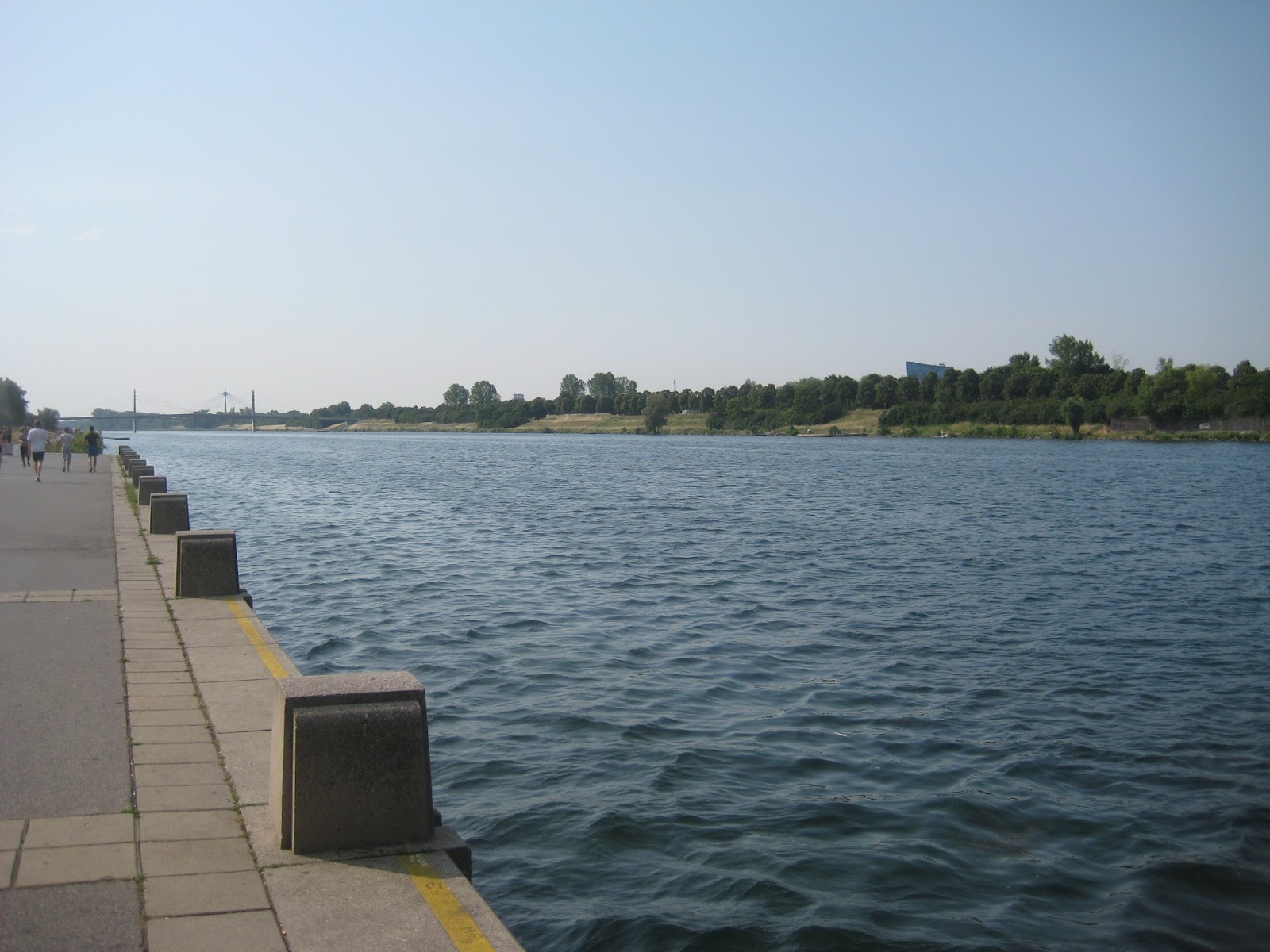
My list for today was a long one, though shorter after I decided not to try and venture out for a Medieval Castle about an hour away from town.  Another time!  Instead, I started with an out-of-the-way ride to the Danube River.  I’m this near to a historical waterway, I have to touch it.  So I did, I took in the sights, the swans, and I made my way back to Old Proper.  Despite what the song says, it’s not blue (and yes, I was listening to it while I was there).
Ok it's looks blue here, but up close it was more green (though not as bad as the Jordan)

My four museum stops for today were all close together.  First was the Natural History Museum.  It has two major claims to fame: the oldest and largest collection of meteors, and the famous Venus of Willendorf, which is 25,000 years old (though interesting they have an even older figure in the same room).  Besides that, it is surprisingly mediocre when compared to Chicago’s Field Museum or, especially with the tiny dinosaur collection, the Houston science museum.
The second oldest gold objects ever found

Isn't she lovely?

And...even older

Ubiquitous dinosaur shot

A tiny portion of their big meteor collection

Across the plaza (with a humongous statue of Maria Teresa) is the Kuntshistoriches Museum, the art museum.  I’ve been blessed to see some great art museums (Louvre, Uffizi, Vatican, to name a few), this is up there with them.  The highlights include Raphael’s Madonna of the Meadow (which has been following me; we studied it in my Michelangelo class and it was outside my door at IPF), Rembrandt, Rubens, Caravaggio, Bruegel, Titian, etc.  As a big fan of Renaissance art, this was a treat.  It was after noon by this time, and I could not find information for any nearby food stops, so I grabbed a quick sandwich at the museum’s café.
Titian's Thesus, like all good European art museums the building is as impressive at the art

Maddona in the Meadow

Caravaggio

Automaton ship centerpiece, the cannons actually fire

They have videos of each of the automatons, but this was my favorite.  You have to stay until the end.

The third stop today was the New Palace, which has three exhibits.  First was the archeological findings from Ephesus.  Second was a huge collection of musical instruments, including two clarinets said to have been played by a young Beethoven (plus his portrait) and the violin of Mozart’s father.  Third was my real interest: the royal arms and armor museum.  Maybe not as impressive as the collection in Paris, but still pretty cool (though room after room of armor gets a little old).  Interestingly, their weapons collection does not include anything from the 20th century.  Almost like they don’t want to remember the world wars.
Young Beethoven and his instruments (the black one and the small one to the right)

Table with drinking songs

Just one set of suits of armor

Lots of guns

The last big stop for the day was the Imperial Treasury.  If only I wasn’t the walking dead by this point, I could have better appreciated all this had to offer.  The treasury includes two Holy Roman Emperor crowns, the royal cradle for the son of Napoleon and one of the Hapsburgs, a golden rose from the pope, the 11th century Imperial Cross including large pieces of the True Cross (with nail hole!) and the Holy Lance, a reliquary with one of the nails said to have been worn by Constantinople, and many other pieces that made the Hapsburgs THE royal family.  And then there was my highlight: the royal ecclesiastical collection.  We’re talking rooms full of chasubles, chalices, monstrances, reliquaries (many not labeled, but some including the apostles, a tooth of John the Baptist, a piece of Jesus’ loin cloth, a piece of the cloth used at the Last Supper, and many others), and all kinds of amazing Church paraphernalia.  It’s a liturgist’s (or seminarian’s) craziest dreams come true.  The only problem was the rooms were very light, and with no flash photography most of my pictures are very dark.  That is until the last room, when I decided to try my phone instead of my camera.  I’ll never mock the iphone camera again.
Golden Rose
HRE crown

True Cross

Holy Lance

When I finished there it was 4:00, so I had about an hour before Mass at St. Peter’s.  I spent some of that time back in St. Michael’s and some of the time roaming the streets.  St. Peter’s is an amazing Baroque church.  I didn’t have much information on it, so I just went by what I saw.  I did notice remains under a couple of the side altars, but I have no idea who they were.  By the way, a quick note about what I observed in two Masses in Vienna.  I was surprised.  Both had at least 60 people for Daily Mass, and from what I could tell they were locals and not tourists.  Today’s Mass was about half people in the 20s and 30s.  Both priests wore fiddleback chasubles.  No homilies.  The priest today held his hands “the old way” during the consecration.  St. Stephen’s uses its altar railing, St. Peter’s does not have an altar railing so people knelt on the lowest step.  And no extraordinary ministers.  They seem pretty traditional to me.  Again, they were pleasant surprises.


Then it was time for dinner.  I won’t go into the whole story, but let’s say I was upset with how difficult it was to find a traditional Austrian restaurant.  I settled for an outdoor café near the cathedral, and went total cliché.  Weiner schnitzel and apple strudel.  They were pretty good.  But now I’m tired.  I can really feel the three plus weeks wearing on me.  As much as I like Vienna and could easily spend more time here, I’m worn out from being away this long.  I’m looking forward to tomorrow.  Not the travel (you can probably tell by now I hate it), but more the fact that, God willing, by 7:00 I will be back in Madison.